Kimi K3 Review: The Largest Open-Source AI Model Ever Built


Kimi K3 Review: The Largest Open-Source AI Model Just Outscored GPT-5.6 and Claude on 12 of 14 Tests
On July 17, Beijing-based Moonshot AI released Kimi K3 — a 2.8-trillion-parameter open-source model. It is now available for free testing at kimi.com, with full model weights dropping on July 27. The company admitted in its own launch post that K3 still trails Claude Fable 5 and GPT-5.6 Sol on overall capability. But the full benchmark picture tells a more interesting story: across 14 real-world coding and agent benchmarks, Kimi K3 ranks first or second in 12 of them — including beating both frontier models on multi-hour coding, autonomous agents, and long-context information retrieval.
Here is the full picture from a comprehensive third-party benchmark run that included all six leading models — K3, Fable 5, GPT-5.6 Sol, Claude Opus 4.8, GPT-5.5, and GLM-5.2 — all tested at maximum reasoning effort.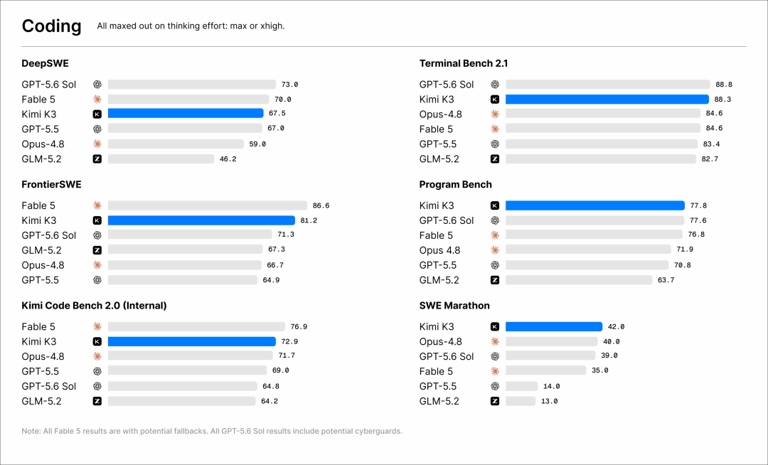
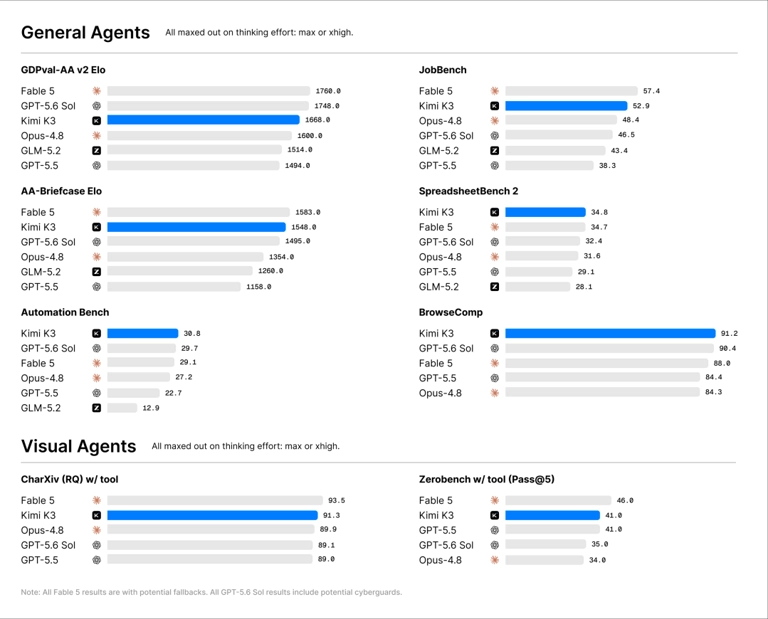
The Full Benchmark Picture
| Benchmark | What It Tests | K3 | Rank | Best Competitor |
|---|---|---|---|---|
| DeepSWE | Real GitHub issue fixing | 67.5 | #3 | GPT-5.6 Sol: 73.0 |
| FrontierSWE | Multi-file refactoring | 81.2 | #2 | Fable 5: 86.6 |
| Terminal-Bench 2.1 | Command-line tasks | 88.3 | #2 | GPT-5.6 Sol: 88.8 |
| Program Bench | General programming | 77.8 | #1 | GPT-5.6 Sol: 77.6 |
| SWE Marathon | Long-horizon coding (multi-hour) | 42.0 | #1 | Opus-4.8: 40.0 |
| Kimi Code Bench 2.0 | Internal coding suite | 72.9 | #2 | Fable 5: 76.9 |
| GDPval-AA v2 | Real-world job tasks (44 occupations) | 1668 | #3 | Fable 5: 1760 |
| AA-Briefcase | Long-horizon knowledge work | 1548 | #2 | Fable 5: 1583 |
| BrowseComp | Long-context information retrieval | 91.2 | #1 | GPT-5.6 Sol: 90.4 |
| JobBench | Professional agent tasks | 52.9 | #2 | Fable 5: 57.4 |
| Automation Bench | Workflow automation | 30.8 | #1 | GPT-5.6 Sol: 29.7 |
| SpreadsheetBench 2 | Spreadsheet reasoning | 34.8 | #1 | Fable 5: 34.7 |
| CharXiv w/ tool | Visual chart reasoning | 91.3 | #2 | Fable 5: 93.5 |
| Zerobench w/ tool | Zero-shot extreme reasoning | 41.0 | #2 | Fable 5: 46.0 |
Score summary: All 14 benchmarks above were run with “max or xhigh” thinking effort. K3 ranks #1 in 5 benchmarks, #2 in 7, and only drops to #3 in 2 (DeepSWE coding and GDPval-AA general agents). The two benchmarks where K3 does not crack the top 2 are exactly the areas where the older frontier models — GPT-5.6 Sol for coding, Fable 5 for general agents — still hold the lead.
Note: All Fable 5 results were run with potential fallbacks enabled; all GPT-5.6 Sol results include potential cybergards. Both restrictions hurt benchmark scores relative to K3, which has no such limitations in its open-source release.
What the Numbers Actually Mean
Where K3 Is Unquestionably the Best
Multi-hour autonomous coding. K3 wins the SWE Marathon at 42.0 — beating Opus-4.8 (40.0), GPT-5.6 Sol (39.0), and Fable 5 (35.0). This benchmark tests whether models can sustain complex engineering work over hours without losing coherence — the kind of work that defines production coding agents.
Workflow automation. K3 takes Automation Bench at 30.8, ahead of GPT-5.6 Sol (29.7) and Fable 5 (29.1). If you are building agentic workflows that handle real business processes, K3 is currently the strongest model you can use.
Spreadsheet and long-context reasoning. K3 is #1 on SpreadsheetBench 2 (34.8) and #1 on BrowseComp (91.2, beating GPT-5.6 Sol’s 90.4 and Fable 5’s 88.0). BrowseComp tests long-horizon information retrieval — the kind of research work analysts, writers, and researchers do every day.
General programming. K3 wins Program Bench (77.8) — a broad coding benchmark — narrowly beating GPT-5.6 Sol (77.6) and Fable 5 (76.8).
Where K3 Is Within Striking Distance
K3 is within 1 point of the leader on SpreadsheetBench 2 (34.8 vs 34.7) and within 0.5 points on Terminal-Bench 2.1 (88.3 vs 88.8). These are statistical ties — the difference is noise.
Where K3 Actually Loses
On DeepSWE (real GitHub issue fixing), GPT-5.6 Sol leads at 73.0 vs K3’s 67.5 — a 5.5-point gap. On GDPval-AA v2 (real-world job tasks across 44 occupations), Fable 5 leads at 1760 vs K3’s 1668 — a 92-point gap. These are the two benchmarks where the frontier models still hold clear advantages.
But there is an important caveat. Fable 5 and GPT-5.6 Sol both have safety restrictions that hurt their benchmark scores. Fable 5’s classifier system routes sensitive queries to a weaker model. GPT-5.6 Sol’s cybergards limit what it can do in coding and agentic contexts. K3 — as an open-source release — has no such restrictions. The benchmark numbers reflect this: K3 is being compared against restricted versions of its competitors, not their full potential.
What K3 Is and What It Is Not
Kimi K3 is a Mixture-of-Experts model with 896 total experts and 16 active per token. It has 2.8 trillion total parameters, a 1-million-token context window, and native visual understanding. It runs in always-on “thinking mode” — every response goes through reasoning, which is part of why it performs so well on agentic tasks but also makes it slower and more expensive than non-reasoning models.
Pricing is $3 input / $15 output per million tokens, with cached input at $0.30. For a coding and agent-focused model, this is reasonable — comparable to Claude Sonnet 5 — but more expensive than DeepSeek V4-Flash ($0.14 / $0.28). The model is free to test at kimi.com. Full weights arrive July 27, meaning developers can self-host, audit, and fine-tune for free.
What K3 is not: it is not the absolute best at any single benchmark. Fable 5 holds the lead on real-world job tasks, GPT-5.6 Sol wins on pure code fixing, and Claude Opus 4.8 is comparable on several agentic tests. But K3 is the most well-rounded of the open-source models in 2026 — and it is the only open-source model in the world that competes with the closed frontier on its own terms. For a broader comparison of open-source models, see our DeepSeek review and our latest AI weekly roundup.
Who Should Try K3 Right Now
Developers building coding agents and autonomous workflows. K3 is the best model in the world for long-horizon, multi-step engineering work. Test it at kimi.com or via the API at $3/$15 per million tokens.
Researchers and analysts. The #1 BrowseComp ranking means K3 is the strongest model for finding, cross-referencing, and synthesizing information across large document sets.
Anyone who self-hosts. Weights drop July 27. Combined with DeepSeek V4, you now have two strong open-source frontier models you can run, audit, and customize on your own infrastructure. See our beginner’s guide for getting started with open-source AI.
Test it for free at kimi.com. Full weights land July 27.
Frequently Asked Questions
Is Kimi K3 better than GPT-5.6?
On 12 of 14 real-world benchmarks — including multi-hour coding, workflow automation, and long-context reasoning — yes. GPT-5.6 Sol still leads on DeepSWE (73.0 vs 67.5), which tests fixing real GitHub issues. But K3 is ahead or within statistical noise on everything else.
Is Kimi K3 really open source?
Yes. Moonshot AI committed to releasing full model weights on July 27, 2026. This means anyone can download, self-host, audit, and fine-tune K3. The model is already available for free testing at kimi.com and via API.
How much does Kimi K3 cost compared to Fable 5?
K3 costs $3 input / $15 output per million tokens — less than a third of Fable 5’s $10/$50. For coding tasks where K3 is already competitive or winning on benchmarks, the cost savings multiply at scale.