Grok 4.5 Review: xAI’s Coding Model Is Genuinely Cheap — but the Benchmarks Tell Two Different Stories

Grok 4.5 Review: xAI’s Coding Model Is Genuinely Cheap — but the Benchmarks Tell Two Different Stories
Last updated: July 19, 2026. This review will be updated if xAI publishes a Grok 4.5 model card.
On July 8, 2026, SpaceXAI released Grok 4.5 — its first model built from the ground up for coding and AI agents, trained on a 1.5-trillion-parameter V9 foundation. Elon Musk described it as “an Opus-class model, but faster, more token-efficient and lower cost.” Two days of independent testing later, the verdict from Artificial Analysis is supportive but measured: Grok 4.5 currently sits at 54 on the Intelligence Index — a 16-point jump over Grok 4.3, ranking it among the top tier, though rankings shift as new models enter evaluation.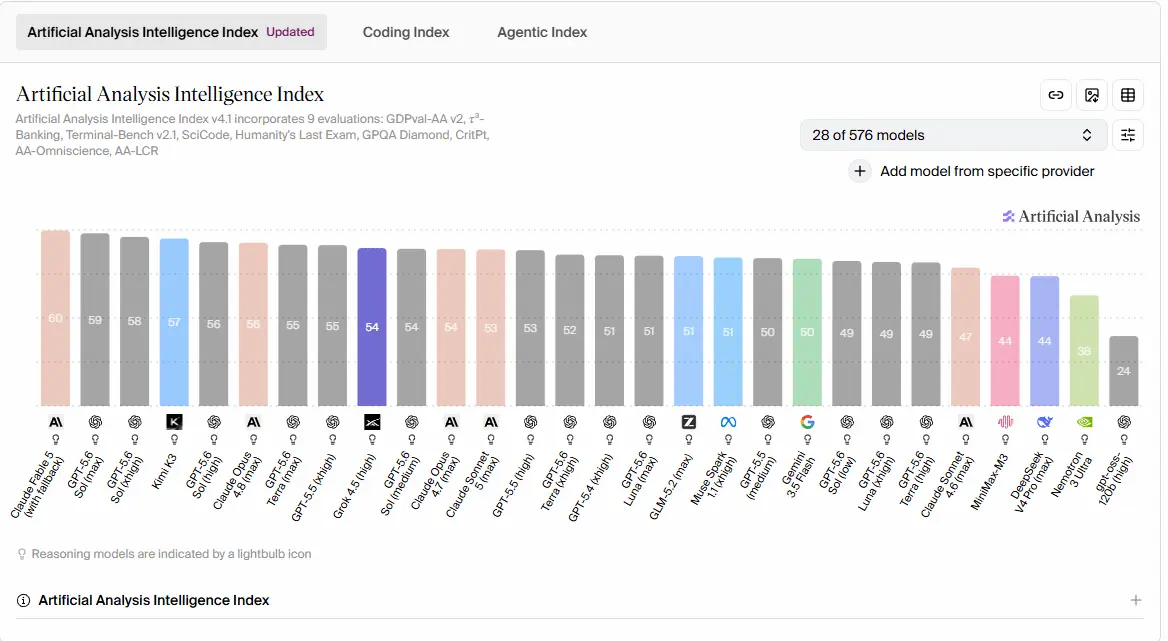
Quick Answer: Grok 4.5 is the strongest cost-per-task option at near-frontier level — but with meaningful caveats. Artificial Analysis data places its per-task cost at roughly one-sixth to one-ninth of its closest competitors. It leads all models on AutomationBench-AA (agentic workflows), SWE Marathon (long-horizon coding), and τ³-Banking (financial reasoning). However, its hallucination rate has doubled to 54% on the AA-Omniscience benchmark, its DeepSWE performance swings 9 points depending on which test harness runs the evaluation, and xAI has not published a model card or safety documentation. This review separates the independently verified numbers from the launch-day marketing.
| ⭐ At a Glance | |
|---|---|
| Rating | 7.8/10 — Strongest cost-per-task option at near-frontier level, with meaningful caveats |
| Best for | High-volume coding agents, terminal work, long-horizon autonomous engineering |
| Pricing | $2 input / $6 output per 1M tokens. Doubles above 200K input context. Cached input: $0.50. |
| Free access | Available inside Cursor on all plans (including free); API with pay-per-token |
| Honest caveats | 54% hallucination rate (AA-Omniscience). Benchmark swings from 62% to 53% depending on test harness. No model card. EU unavailable at launch. |
The Benchmark Reality: Two Harnesses, Two Stories
The most important number in the Grok 4.5 launch is not any single benchmark score. It is the gap between two versions of the same test — a finding first highlighted by Awesome Agents in their July 10 review.
On DeepSWE 1.0 — the provider-controlled harness where xAI designs the scaffolding — xAI reports that Grok 4.5 scores 62.0%, beating Opus 4.8’s 55.75% by roughly 6 points. On DeepSWE 1.1 — the neutral mini-swe-agent harness run independently — Grok 4.5 drops to 53%, now trailing Opus 4.8’s 59% and GPT-5.5’s 67%, according to SpaceXAI’s own published data. That is roughly a 9-point swing. It is not noise. It suggests the model is sensitive to how task scaffolding is set up — which matters for anyone planning to build their own agentic pipelines on top of it.
This sensitivity to test infrastructure is not unique to Grok 4.5. All frontier models perform differently depending on the harness. But the Grok 4.5 gap is unusually wide, and Cursor disclosed at launch that an earlier snapshot of its codebase accidentally ended up in Grok 4.5’s training data. This inflates scores on CursorBench-derived evaluations, though independent benchmarks like DeepSWE and SWE-Bench Pro are not affected.
Where Grok 4.5 Genuinely Leads
Long-horizon autonomous coding. On SWE Marathon — the hardest test of sustained, multi-hour software engineering — xAI reports Grok 4.5 at 29.0% resolution rate, ahead of Opus 4.8’s 26.0% and Fable 5’s 24.0%. This benchmark most closely simulates what coding agents actually do: start from a problem, work through a codebase across multiple steps, and produce a working solution.
Real-world agentic workflows. On AutomationBench-AA — 657 tasks across 40 simulated enterprise apps including Gmail, Slack, and Salesforce — Grok 4.5 scores 51.4%, according to Artificial Analysis data. This is the first model to complete more than half of workflow objectives without violating business constraints. Fable 5 scored 48.6% and Opus 4.8 scored 48.5%, both at significantly higher per-task cost.
Terminal work. On Terminal-Bench 2.1 — command-line tasks and system operations — Grok 4.5 scores 83.3%, within a single point of both Fable 5 (84.3%) and GPT-5.5 (83.4%), based on xAI’s published benchmarks. For DevOps, infrastructure, and systems programming, Grok 4.5 is genuinely competitive with the frontier.
Financial reasoning. On τ³-Banking — a banking customer-service agent benchmark — Grok 4.5 scores 33%, edging out GPT-5.5 at 31%, according to Artificial Analysis. On GDPval-AA v2, it ranks #4 with an Elo of 1,543, behind only Fable 5, GPT-5.6 Sol, and Opus 4.8. Snorkel AI’s independent GDPVal+ evaluation found Grok 4.5 reaching 29% mean pass rate against 22% for GPT-5.5, with concentrated gains in legal work (40% vs 27-28%) and education (58% vs 35-42%). These are surprisingly strong results for a model pitched primarily as a coding tool.
Honest Caveats
1. The hallucination rate doubled from Grok 4.3. On Artificial Analysis’ AA-Omniscience benchmark — which measures whether a model confidently provides wrong answers at knowledge boundaries — Grok 4.5 scored a 54% hallucination rate, up from Grok 4.3’s 25%. This is not a universal 54% hallucination rate across all tasks; it is a benchmark-specific result. But it means the model is more confident when wrong, which is harder to catch in practice than lower-confidence errors. For coding tasks where outputs are verifiable through tests, this is manageable. For research, content generation, or customer-facing applications where answers are accepted without automated verification, it requires human review.
2. Hard, multi-step codebase reasoning lags the frontier. On SWE-Bench Pro — a successor to the original SWE-bench with less training data contamination — Grok 4.5 scores 64.7%, well behind Fable 5’s 80.4% and Opus 4.8’s 69.2%, based on SpaceXAI’s published benchmark data. For the most complex autonomous engineering — the kind where getting it wrong means hours of wasted debugging — Fable 5 remains the stronger option. For a comparison of Fable 5 against GPT-5.6, see our head-to-head breakdown.
3. The 500K context window is a downgrade. Grok 4.3 offered 1 million tokens. Grok 4.5 ships with 500K. xAI has not publicly explained the reduction. For developers working across large codebases or long documents, this is a real constraint.
4. Reasoning runs at high effort by default and cannot be turned off. Every query — even a simple one-line request — goes through full reasoning, according to xAI’s API documentation. This means trivial calls consume more tokens and add latency compared to models where reasoning is configurable.
5. Long-context pricing doubles above 200K tokens. The base rate of $2/$6 applies to inputs under 200K. Above that threshold, pricing increases — a detail xAI’s launch blog did not prominently disclose but which the API documentation confirms.
6. No model card or safety documentation. As of publication, xAI has not published a Grok 4.5-specific model card or system card. That does not prove the model is unsafe. It means outside reviewers have less evidence. For regulated industries, this should be treated as an open item.
7. EU unavailable at launch. European developers cannot use Grok 4.5 yet. xAI targeted mid-July 2026 for regional availability, with no confirmed date as of this review.
Pricing: The Numbers That Actually Matter
At $2/M input and $6/M output, Grok 4.5 prices well below its nearest performance competitors. Artificial Analysis measures Grok 4.5 using roughly 14,000 output tokens per Intelligence Index task — over 60% fewer than Opus 4.8. On SWE-Bench Pro, xAI reports Grok 4.5 averaging roughly 15,954 output tokens per resolved task against Opus 4.8’s 67,020 — a roughly 4x efficiency gap. Combined with the lower per-token price, Artificial Analysis estimates Grok 4.5 at about $0.31 per Intelligence Index task, roughly one-sixth of Opus 4.8’s $1.80 and one-ninth of Fable 5’s $2.75.
| Model | Input (per 1M) | Output (per 1M) | Tokens per SWE-Bench Pro task | Est. cost per task | Source |
|---|---|---|---|---|---|
| Grok 4.5 | $2.00 | $6.00 | ~15,954 | ~$0.10 | xAI / Artificial Analysis |
| Claude Opus 4.8 | $5.00 | $25.00 | ~67,020 | ~$1.68 | xAI / Artificial Analysis |
| Fable 5 | $10.00 | $50.00 | — | ~$2.75 (AI Index) | Artificial Analysis |
| GPT-5.6 Sol | $5.00 | $30.00 | — | ~$1.04 | Artificial Analysis |
The cost argument is real. But precise cost multiples depend on token consumption patterns, and individual workloads will vary. For teams running thousands of coding agent operations per day, the per-task cost difference between Grok 4.5 and Opus 4.8 is substantial. For occasional use, the absolute dollar difference is small enough that model quality should be the deciding factor. For a broader pricing comparison, see our DeepSeek review and Kimi K3 review.
Who Should Use Grok 4.5
Use it for: High-volume coding agents where cost is the binding constraint. Autonomous, multi-hour engineering sessions (SWE Marathon leader). Terminal work and systems programming. Financial or legal knowledge work where results can be verified. Cursor users who want the default model optimized for their editor.
Skip it for: Tasks requiring factual reliability without human review (54% hallucination rate on AA-Omniscience). Complex multi-file refactoring where Fable 5’s lead on SWE-Bench Pro matters. Any workload needing more than 500K tokens of context. Regulated industries — no published model card or safety documentation. EU-based work — not yet available.
Frequently Asked Questions
Is Grok 4.5 really Opus-class?
On two of four benchmarks published by xAI, Grok 4.5 beats Opus 4.8. On the other two, it trails. On the neutral DeepSWE 1.1 harness, it is behind. Artificial Analysis ranks Grok 4.5 #4 on the Intelligence Index among tracked frontier models. “Opus-class” is fair as a rough performance tier, but Grok 4.5 is not a clear capability upgrade over Opus 4.8. Its real edge is cost and speed, not raw performance.
Why do benchmarks show different results depending on the test harness?
Scaffolding matters. Each coding agent platform — Grok Build, Claude Code, Codex — has its own prompt engineering, retry logic, and tool definitions. A model optimized inside one harness may underperform inside another. The roughly 9-point gap between Grok 4.5’s DeepSWE 1.0 (provider harness) and DeepSWE 1.1 (neutral harness) is a concrete example, first analyzed by Awesome Agents.
What is the biggest risk with Grok 4.5?
The 54% hallucination rate on the AA-Omniscience benchmark, as measured by Artificial Analysis — roughly double Grok 4.3’s 25%. This is a benchmark-specific result, not a universal rate across all tasks. But it means the model is more confident when wrong, creating risk for any application where users trust outputs without verification. For coding, this is manageable because wrong code visibly fails. For research, content, or customer-facing use, it requires human review.
Can I use Grok 4.5 for free?
Yes — inside Cursor on the free plan, where Grok 4.5 is the default model. The xAI API charges $2/$6 per million tokens, with no free tier. Consumer access requires a subscription (SuperGrok Lite at $10/month or X Premium+ at $40/month), according to xAI’s launch documentation.
How does Grok 4.5 compare to DeepSeek V4 for coding cost?
DeepSeek V4-Flash is far cheaper per token ($0.14/$0.28), but Artificial Analysis data suggests Grok 4.5’s significantly higher token efficiency means it completes tasks with fewer tokens, narrowing the gap. On agentic benchmarks like SWE Marathon, Grok 4.5 leads DeepSeek by a wide margin based on xAI’s published data. For routine coding where cost dominates, DeepSeek may be more economical. For autonomous engineering where finishing the task matters, Grok 4.5 currently leads. Our DeepSeek review covers the full comparison.
The Bottom Line
Grok 4.5 is the strongest cost-per-task option in the near-frontier tier available today. The SWE Marathon lead is backed by xAI’s published data. The AutomationBench-AA #1 position is confirmed by Artificial Analysis. The per-task savings are substantial at scale. But the model is not a drop-in replacement for Opus 4.8 or Fable 5 on every workload. It is a specialized tool — exceptionally efficient for verifiable coding work and long-horizon autonomous engineering, with risk factors that require careful handling in any unsupervised or accuracy-critical application.
My coding stack: Grok 4.5 for routine agentic tasks where the cost savings compound, Fable 5 for complex multi-file refactoring, Opus 4.8 for anything I cannot afford to get wrong. For more frontier model comparisons, see our AI writing tools guide and Kimi K3 review.
Sources
- Introducing Grok 4.5 — xAI (July 8, 2026)
- Introducing Grok 4.5 — Cursor Blog (July 8, 2026)
- Grok 4.5 Intelligence, Performance & Price Analysis — Artificial Analysis (July 9-10, 2026)
- Grok 4.5 Review: Agentic Speed at Half the Price — Awesome Agents (July 10, 2026)
- Grok 4.5 Testing Results — Snorkel AI (July 2026)
- Grok 4.5 API Documentation — xAI
- xAI API Pricing
- Launch coverage via TechCrunch, VentureBeat, The Decoder