DeepSeek V4 Flash Review: 7x Better Agent Coding, 3x Cheaper Than Pro


Published: July 31, 2026
DeepSeek dropped a curveball on the last day of July. The official public-beta release of DeepSeek V4 Flash (model ID: deepseek-v4-flash-0731) uses the exact same 284B-parameter Mixture-of-Experts architecture as the April preview — no new parameters, no bigger context window — but a completely redone post-training phase pushed its agent benchmarks past DeepSeek’s own V4-Pro-Preview on nearly every metric.
A Flash model beating a Pro model. At roughly one-third the price. On the same day OpenAI slashed GPT-5.6 Luna pricing by 80% and Terra by 20%.
This is not just another model update. It signals a shift in how the AI industry is creating value: the next wave of capability gains may come not from bigger pretraining runs, but from smarter post-training.
Bottom Line: DeepSeek V4 Flash’s official release delivers agent-coding benchmarks that surpass its own preview-grade Pro model, at $0.14 per million input tokens — roughly 3x cheaper than V4-Pro and 21x cheaper than Claude Sonnet 5. On Terminal Bench 2.1 it scores 82.7, closing in on Claude Opus 4.8’s ~85.0. For budget-conscious developer teams, this is currently the strongest agent-coding model per dollar on the market.
DeepSeek V4 Flash at a Glance
- Architecture: Mixture-of-Experts, 284B total / 13B active parameters (unchanged from April preview)
- What changed: Complete post-training rework — same weights, different fine-tuning
- Context window: 1M tokens input, 384K max output
- Pricing: $0.14 / $0.28 per 1M tokens (cache-miss input / output) — 3.1x cheaper than V4-Pro
- Concurrency: 2,500 simultaneous requests (vs 500 for Pro)
- API features: Native OpenAI Responses API (Codex-ready), Anthropic message format
The Benchmark Leap: Flash Overtakes Pro
The numbers that matter most are not the absolute scores — they are the deltas. Every benchmark DeepSeek published today shows the July 31 Flash release outperforming the April V4-Pro-Preview, a model with 1.6 trillion parameters and roughly 4x the active parameter count.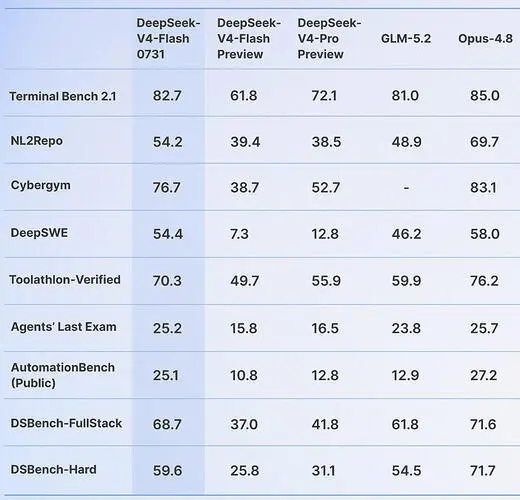
Two numbers deserve special attention:
DeepSWE: 7.3 → 54.4. This is not a typo. The model improved more than sevenfold on software engineering agent tasks in a single post-training cycle. DeepSWE measures how well a model navigates real code repositories, understands project structure, and makes meaningful edits — the kind of work a junior developer does daily. A score of 54.4 puts Flash within competitive range of frontier coding models.
Cybergym: 38.7 → 76.7. Nearly double. This benchmark evaluates cybersecurity agent tasks, and the jump suggests the post-training specifically emphasized tool use and multi-step reasoning rather than just knowledge recall.
The updated table above also shows how Flash 0731 stacks up against GLM-5.2 (Zhipu AI’s recent release) and Claude Opus 4.8. Flash beats GLM-5.2 on every benchmark where both have data, often by substantial margins. Against Opus 4.8, Flash trails on most metrics — but the gap is small (typically 2-6 points), except on NL2Repo where Opus 4.8 leads by 15.5 points and DSBench-Hard where Opus leads by 12.1 points. At roughly one-twentieth the cost, those gaps become strategic questions rather than disqualifying ones.
How Flash Compares to the Frontier
The updated benchmark table reveals three distinct competitive stories:
1. Flash has overtaken DeepSeek’s own V4-Pro on agent tasks. Across all 9 benchmarks in the table, Flash 0731 scores higher than V4-Pro-Preview — often by 20+ points. DeepSWE: 54.4 vs 12.8. Cybergym: 76.7 vs 52.7. DSBench-Hard: 59.6 vs 31.1. This is unusual: a Flash-tier model outperforming a Pro-tier model with 1.6T parameters and 49B active (vs 13B). The only explanation is that post-training, not parameter count, drove the agent capability gains.
2. Flash beats GLM-5.2 across the board. Zhipu AI’s GLM-5.2 — the same model Hugging Face used to perform forensic analysis on the OpenAI security breach — has been one of the most talked-about Chinese releases of 2026. Yet Flash 0731 outperforms it on every benchmark where both have data: Terminal Bench (+1.7), NL2Repo (+5.3), DeepSWE (+8.2), Toolathlon (+10.4), Agents’ Last Exam (+1.4), AutomationBench (+12.2), DSBench-FullStack (+6.9), DSBench-Hard (+5.1). For Chinese AI in particular, this is the new state of the art on agent benchmarks.
3. Opus 4.8 still leads, but the gap is closing. Claude Opus 4.8 remains the strongest model in this comparison, winning 8 of 9 benchmarks. But the deltas are smaller than the price gap suggests: most are 2-6 percentage points, with two notable exceptions (NL2Repo +15.5 in Opus’s favor, DSBench-Hard +12.1). Opus 4.8 costs approximately $5/$25 per million tokens — roughly 35x more expensive than Flash on input. The question for buyers becomes: at what point does paying 35x more for a 2-6 point improvement stop making sense?
Pricing: 3x Cheaper Than Pro, 21x Cheaper Than Sonnet 5
The economics are where this release gets genuinely disruptive:
| Model | Input (per 1M tokens) | Output (per 1M tokens) | Relative Cost |
|---|---|---|---|
| Claude Sonnet 5 | $3.00 | $15.00 | 21.4x Flash |
| GPT-5.6 Luna | $1.00 | $6.00 | 7.1x Flash |
| DeepSeek V4 Pro | $0.435 | $0.87 | 3.1x Flash |
| DeepSeek V4 Flash | $0.14 | $0.28 | Baseline |
With cache-hit pricing dropping to $0.0028 per million input tokens — effectively free for repeated system prompts — the economics of building agentic products shift meaningfully. Byteiota estimates that a team spending $1,000 per month on Claude Sonnet 5 could run equivalent Flash workloads for approximately $47.
DeepSeek is not competing on margins. It is resetting the floor.
One caveat: DeepSeek has indicated plans for peak/off-peak pricing during Beijing business hours (09:00-12:00 and 14:00-18:00 Beijing time), at 2x the listed rates. The policy has not yet taken effect, but teams building around Flash should model for it.
What “Only Post-Training” Actually Means
DeepSeek was unusually transparent about what changed in this release: “the model structure and size are the same as the Preview version, and only post-training was redone.” For practical purposes, this is significant.
Pretraining is where a model absorbs knowledge — trillions of tokens of text and code, learning the patterns of language and reasoning. Post-training is where it learns how to work: following instructions, calling tools, verifying its own output, recovering from errors, and completing multi-step tasks without getting lost.
The April Flash preview was a capable base model with weak agent skills. The July 31 release is the same brain, retrained to operate in a development environment — reading files, navigating repositories, running commands, interpreting error messages, and iterating until a task is complete.
AI科技评论 compared it to a car: same engine, but the transmission, control systems, and driving strategy were retuned. The result handles specific roads dramatically better.
For developers, the practical implication is straightforward: the model you called three months ago with the same API endpoint is now meaningfully better at actually completing tasks. No code changes required.
Practical Considerations: What to Know Before Switching
✅ Strengths
- Unmatched cost-to-performance ratio for agentic coding. Terminal Bench 82.7 at $0.14/M input is currently the best deal in AI.
- Native Codex integration. Flash is the only DeepSeek model supporting OpenAI’s Responses API format, meaning Codex workflows work out of the box with zero configuration changes.
- 2,500 concurrent requests. Five times the Pro model’s concurrency limit, making it suitable for production agent pipelines.
- 1M token context. Full repository ingestion. No truncation needed for most projects.
- Cache-hit pricing nearly free. $0.0028/M tokens for repeated prompts makes RAG and agent loops economically viable at scale.
⚠️ Limitations
- API-only. No web or app update. You cannot try this in DeepSeek’s chat interface. Only available through the API endpoint.
- Vendor-reported benchmarks only. All the scores above are from DeepSeek’s own evaluations, using their internal harness. Independent verification from Artificial Analysis and other third-party testers is not yet available as of July 31.
- Data processed on Chinese servers, subject to Chinese law. Organizations handling sensitive data should evaluate compliance requirements before routing production workloads through DeepSeek’s hosted API.
- Peak pricing risk. The planned 2x surcharge during Beijing business hours could significantly affect teams operating in APAC time zones.
- Still below frontier on raw reasoning. Flash excels at agentic execution tasks, but for the hardest reasoning problems — math proofs, novel scientific reasoning — the 13B active parameter count has a ceiling that 49B+ active models do not.
What This Means: Post-Training Is the New Battlefield
The broader significance of this release extends beyond DeepSeek. For years, the industry narrative has been that bigger pretraining runs drive capability gains. DeepSeek V4 Flash challenges that assumption directly: same pretrained weights, radically different post-training, dramatically better agent performance.
If post-training can deliver a 7x improvement on DeepSWE and a 2x improvement on Cybergym without touching the base model, then the economic logic of AI development shifts. Pretraining is a capital-intensive one-time cost. Post-training is cheaper, faster to iterate, and — as Flash demonstrates — capable of unlocking capabilities that were latent in the base model all along.
This also raises an uncomfortable question for Anthropic and OpenAI: if a 284B model with only 13B active parameters can approach Opus 4.8-level agent performance at 1/20th the cost, what exactly are customers paying for with frontier models?
The answer, for now, is reliability, safety, and ecosystem. Claude Opus 5 still outperforms Flash on most benchmarks, and Anthropic’s safety infrastructure and enterprise support are real value-adds. But the gap is closing faster than anyone expected.
Our Research Methodology
At The Pick Log, our reviews are research-based. This analysis draws on:
- Official sources: DeepSeek’s July 31 changelog, API documentation and pricing page, and published benchmark data.
- Third-party analysis: Byteiota’s detailed benchmark comparison, Digital Applied’s pricing ledger and cost modeling, Toolworthy’s technical summary, and DevelopersDigest’s agent benchmark breakdown.
- Industry context: 智东西、AI科技评论、爱范儿 reported on the release and its implications for the broader AI pricing war.
All benchmark figures are vendor-reported unless otherwise noted. Independent third-party verification is pending as of publication date.
Verdict
DeepSeek V4 Flash is the strongest argument yet that the AI industry’s pricing floor has not been found. A model that beats its own Pro variant on agent benchmarks, outperforms GLM-5.2 on every comparable metric, and trails Opus 4.8 by only single-digit percentages on most tasks — at one-third to one-thirty-fifth the cost, with 2,500 concurrent requests and native Codex support — is not supposed to exist. And yet here it is, in public beta, with a single-line code change to upgrade.
For developer teams currently paying $3.00/M tokens for Claude Sonnet 5 or $1.00/M for GPT-5.6 Luna, moving at least a portion of agentic coding workloads to Flash 0731 is a near-zero-risk experiment with a potential 90%+ cost reduction. The API structure is compatible, the benchmarks are public, and the stakes of trying it are measured in cents.
The biggest uncertainty is how much further post-training can take the V4 architecture. With V4-Pro’s official release expected in early August, DeepSeek may have more cards to play. For now, Flash 0731 is the budget coding agent to beat.
Affiliate disclosure: Some links in our content may earn us a commission at no extra cost to you. Our reviews are research-based and never influenced by affiliate relationships.