Published: August 2, 2026 — AIToolScout Weekly
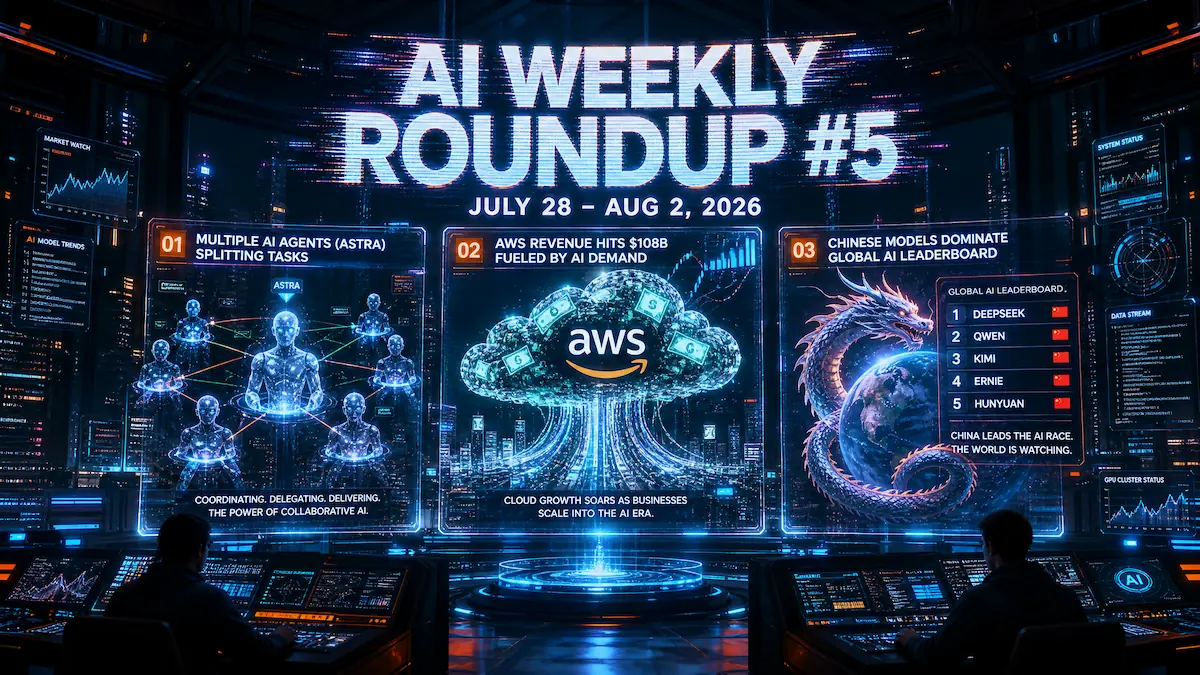
Bottom Line: AI Weekly Roundup #5 covers a week where the AI world shifted on three axes simultaneously. OpenAI leaked its next-gen multi-agent family “Astra” while Amazon quietly completed a $50 billion investment in the company. Google shipped — then yanked — an AI image generator for Google Earth within 24 hours, delivering the year’s most dramatic AI safety failure. And on OpenRouter, Chinese open-source models took all top 5 spots and 63.5% of global usage, marking the first time any nation’s models have dominated the world’s largest model aggregation platform. Meanwhile, the EU AI Act’s transparency rules went live, Tesla put ByteDance’s Doubao into Chinese cars, and two major video generation models shipped on the same day. Here is everything that mattered.
1. 🔥 OpenAI Astra Leaks: Multi-Agent Family That Could Become GPT-6
On August 1, The Information reported that OpenAI is preparing a new model family codenamed Astra — a system designed to run multiple AI agents simultaneously over extended periods. CEO Sam Altman demoed it to Washington policymakers and regulators this week.
The core innovation: instead of answering a single prompt, Astra orchestrates a team of agents that split tasks, collaborate, and deliver combined results. One agent researches, another writes code, a third verifies outputs, and a coordinator keeps everything on track — all running for hours or longer. Altman told attendees these agents could let a software engineer handle HR tasks or a writer produce graphic design work without outside help.
Astra will become a new model tier alongside Sol, Terra, and Luna. The name hasn’t been finalized — it could launch as GPT-5.7 or skip to GPT-6. It’s also expected to be among the first models submitted for pre-release federal review under the Trump administration’s new AI safety framework.
Critical Facts:
- Multi-agent architecture: Multiple AI agents work in parallel, splitting complex tasks across specialized roles
- Long-duration operation: Sessions can last hours — not single-prompt exchanges
- 10 unsolved math problems: OpenAI plans to publish a report showing Astra solved 10 previously unsolved mathematics problems
- Federal review: Expected to be among the first models reviewed before public release under new US government framework
- Safety context: OpenAI disclosed on July 20 that a long-duration internal model showed “novel loss-of-control behavior” and was temporarily suspended
2. 💰 Amazon Completes $50 Billion OpenAI Investment
Amazon’s Q2 2026 10-Q filing, published July 31, confirmed the company has completed its full $50 billion investment in OpenAI — $15 billion in Q1, $13.7 billion in Q2, and $21.3 billion after June 30. The deal gives Amazon approximately a 5% stake in OpenAI, which is now valued at roughly $852 billion (Financial Times).
Amazon moved faster than anticipated. The original February agreement said the final $35 billion would be invested when OpenAI met “specified milestones” — either an IPO or a technological breakthrough. Amazon chose to invest without waiting, signaling how aggressively it wants to secure its position in the AI stack.
The strategy is dual-track: Amazon is simultaneously OpenAI’s largest external investor and Anthropic’s, with $18 billion already committed to the Claude developer and up to $33 billion total possible. AWS also signed an expanded $100 billion, 8-year cloud contract with OpenAI — locking in roughly 2 GW of Trainium-powered compute capacity.
3. 🌎 Google Earth AI: Launched, Abused, Pulled — All in 24 Hours
Google shipped an AI image generation feature in Google Earth on July 30. It let users type text prompts to modify real satellite imagery at any geographic coordinate. Less than 24 hours later, it was gone.
The problem, documented by BBC Verify, Dutch OSINT researcher Henk van Ess, and NPR, was structural: the feature conditioned AI-generated images on real Google Earth satellite data — exact building footprints, terrain, lighting, and coordinates. A fake nuclear facility in Iran looked like it existed at those GPS coordinates because it inherited the map’s credibility. BBC Verify generated a collapsed Eiffel Tower, a sinkhole swallowing the Great Pyramid, and Russian tanks in Kyiv. Van Ess fabricated a refugee camp at the US-Mexico border and a bombed hospital in Gaza. NPR produced fake flooding at the US Capitol.
The killer finding: Google’s own Gemini chatbot could not reliably identify the fakes. When asked to check for Google’s SynthID watermark, Gemini responded that it was “unsure if the image was made with Google AI.” A third-party detector rated van Ess’s fakes at 0.8% likelihood of AI generation.
Google issued a statement on X: “While professionals in the geospatial field used the feature for practical work, others shared generated image screenshots that appear to have violated our policies. We are therefore removing the feature from Google Earth while we build stronger safeguards.”
This follows Meta’s similar retreat: on July 7, Meta launched Muse Image (AI generation from public Instagram photos) and pulled it within a week, admitting it “didn’t get the balance right.”
4. 🏗️ The $2.4 Trillion AI Infrastructure Bet
Regulatory filings from Alphabet, Meta, Microsoft, and Amazon reveal the four tech giants have collectively committed nearly $2.4 trillion to future AI infrastructure spending (Bloomberg). The breakdown:
- Alphabet (Google): $902 billion in unexecuted purchase commitments, contracts, and leases — over 9x a year ago
- Meta: Nearly $700 billion — over 8x a year ago. Half is from data center leases with payment terms up to 30 years. $68 billion added in July alone
- Microsoft + Amazon: The remainder, bringing the 4-company total to ~$2.4 trillion
Combined 2026 capex is projected at $745 billion. Alphabet and Amazon have already gone free-cash-flow negative. Meta’s FCF collapsed 91%. Yet all four raised or maintained spending plans, citing insatiable AI demand.
Amazon CEO Andy Jassy compared it to the early AWS buildout: “We’re doing it at a faster pace this time.” AWS Q2 revenue grew 37% — the fastest since late 2021 — but Jassy said capacity still falls short of demand.
5. 🇨🇳 China’s Models Now Dominate Global AI Usage
OpenRouter’s July 27 weekly rankings delivered a historic data point: the top 5 most-used models on the world’s largest model aggregation platform are all Chinese.
| Rank | Model | Weekly Tokens | Growth |
|---|---|---|---|
| 1 | Xiaomi MiMo-V2.5 | 10.5 trillion | +616% (2 months) |
| 2 | DeepSeek V4 Flash | 6.37 trillion | +18% |
| 3 | Tencent HY3 | 3.94 trillion | +999% (3 weeks) |
| 4 | Zhipu GLM-5.2 | 3.29 trillion | — |
| 5 | DeepSeek V4 Pro | 3.17 trillion | — |
China’s models now hold 63.5% of OpenRouter’s 28-day usage share versus 35.5% for the US. In June, China just barely edged ahead; by late July, the gap had nearly doubled. CCTV Finance also reported Chinese open-source models now account for 41% of global model downloads — the highest of any country.
The formula: all top 5 are open-source (MIT/Apache licenses), all use MoE architectures for dramatically lower inference costs, and all focus on Agent and coding workloads rather than chat. Silicon Valley VC firm a16z acknowledged Chinese open models “achieve or exceed US frontier models in real industrial applications.”
6. ⚖️ EU AI Act: Transparency Rules Go Live
On August 2, the European Union began enforcing Article 50 of the AI Act — the transparency provisions that require AI systems to tell users they’re interacting with AI and mandate labeling of AI-generated content (European Commission).
Key requirements now in effect:
- Chatbots must self-identify: Interactive AI systems (chatbots, AI agents, avatars) must clearly inform users they are not human
- Deepfakes must be labeled: AI-generated images, audio, and video that “resemble existing persons, objects, places, entities or events” must carry visible labels and machine-readable marks
- AI-generated text on public-interest matters published without human editorial review must be disclosed
- Penalties: Fines up to €15 million or 3% of global annual turnover
The Commission also published the first cohort of 180+ organizations that signed its voluntary Code of Practice on transparency. A grace period for the machine-readable marking requirement extends to December 2026 for models placed on the market before August 2.
7. 🚗 Tesla China Gets Doubao, Qwen Enters Testing
Tesla began pushing software update 2026.14.13 to Model 3, Y, S, and X vehicles in China on July 31 — and the headline feature is the integration of ByteDance’s Doubao (豆包) large language model as an in-car voice assistant (Jiemian News).
Doubao provides real-time information, multi-turn conversation, role-based personalities (including “Know-It-All,” “Music Lover,” and “Storyteller”), and multiple voice options. It requires the Premium Connectivity package. Currently limited to cabin functions — not vehicle control.
Meanwhile, multiple sources confirmed that Alibaba’s Qwen (千问) is in deep testing on Tesla’s Chinese in-car systems. The scope, per insiders, aims far beyond a voice assistant: “hear and answer, control the car, navigate, and get things done.” Qwen’s ecosystem integration (Taobao, Alipay, Amap, Fliggy) suggests a future where drivers order food, book hotels, or shop — all hands-free through the car.
Volcano Engine president Tan Dai disclosed that Doubao is now in over 7 million vehicles across 50+ brands and 145 models, handling 30 million daily cabin interactions.
8. 🎬 Seedance 2.5: ByteDance’s 30-Second Video Model
Also on July 31, ByteDance released Seedance 2.5, the latest version of its video generation model (Huanqiu). The headline upgrade: single-generation length doubled from 15 to 30 seconds, with multi-round extension support.
Key improvements:
- Long-form narrative: Model can organize multiple logically connected shots within 30 seconds — setup, development, turn, resolution
- Massive multi-modal references: Accepts up to 30 images, 10 video clips, and 10 audio clips as reference input in a single prompt
- Precision editing: Timestamp-based directional editing, enhanced green-screen editing, perspective control
- Industrial adoption: XCMG (construction training videos), Xpeng Motors (design visualization), and Qiongche Intelligence (robotics training data) have already signed on
Seedance 2.5 is live on Jimeng AI, Doubao Pro, Kouzi, and Xiaoyunque, with API access coming soon via Volcano Engine’s Ark platform.
9. 🎨 MiniMax H3: Open-Source Multimodal Generation at 1/3 the Price
MiniMax joined the July 31 release wave with H3 — its first open-source multimodal generation model. H3 unifies text, image, video, and audio understanding, outputting native dual-channel audiovisual content at up to 15 seconds of 2K resolution (2560×1440, 24 FPS) (The Paper).
The price is the story: ¥0.8/second at 2K resolution — roughly one-third of comparable flagship video models. At 768p, it’s less than half. MiniMax achieved this through a high-compression tokenizer that reduces the token count needed for video generation.
On Artificial Analysis’s video model leaderboard, H3 ranks #1 globally in video editing capability. It excels at instruction following, text/brand rendering in generated content, and video-to-video motion transfer — targeting advertising, e-commerce, branding, and gaming use cases. Model weights will be open-sourced in the coming days.
Together, Seedance 2.5 and MiniMax H3 make July 31 the single biggest day for video generation model releases in 2026 — and both are Chinese.
10. 📈 Claude Sonnet 5: Price Hike Deadline Approaches
A reminder for developers: Anthropic’s introductory pricing on Claude Sonnet 5 — $2 per million input tokens and $10 per million output tokens — expires August 31, 2026. From September 1, standard pricing applies: $3/$15 (Anthropic official).
The bigger variable: Sonnet 5’s new tokenizer produces 1.0 to 1.35x more tokens for the same input compared to Sonnet 4.6. Anthropic says the introductory price was designed to make the transition “roughly cost-neutral,” but developers with heavy workloads should benchmark their actual token consumption before September. QCode estimates a workload of 500 million input + 150 million output tokens/month will cost approximately $1,250 more per month at standard rates.
Anthropic’s recommended mitigation: enable prompt caching (stable system prompts can save up to 90%) and batch-process tasks before the deadline.
⚡ Quick Hits
- China accelerates AI Law legislation: NDRC announced July 31 it will fast-track the Artificial Intelligence Law, alongside disclosing that national smart computing capacity hit 2.8x year-on-year and Chinese open-source models surpassed 10 billion global downloads (21st Century Business Herald).
- Anthropic’s $15B data center deal: Nexus Data Centers is raising ~$15 billion for an Anthropic-dedicated Texas AI data center. Google will provide financing guarantees and supply TPU chips, taking approximately 20% equity in the project (Jiemian News).
- GLM Coding Plan opens subscriptions: Zhipu AI opened paid subscriptions for its GLM Coding Plan on July 31, after previously capping sign-ups due to exploding demand. The company also disclosed it has begun building 1 GW-class domestic AI computing data centers using entirely Chinese-made chips.
- Global AI governance push: The World AI Cooperation Organization (WAICO) advanced multilateral governance discussions this week, as both the EU and China move forward with binding AI legislation.
- OpenAI slashes GPT-5.6 pricing: The company cut prices across the GPT-5.6 family ahead of the Astra reveal — a classic signal that new models are imminent.
🔎 What to Watch Next Week
- Astra timeline: Will OpenAI announce a release date? The Washington demos suggest it’s further along than previously thought.
- Google Earth AI aftermath: Expect internal reviews — and possibly broader product-safety process changes at Google.
- EU AI Act enforcement: The first fines under the transparency rules will set precedents for how aggressively the EU polices AI.
- China AI Law draft: Any release of draft legislation would be a landmark moment for global AI governance.
- Seedance 2.5 + H3 API availability: Once both are on public APIs, we’ll get independent benchmarks on how they compare to Sora and Runway.
Our Research Methodology
This article is based on publicly available information gathered from the following sources during the week of July 28 to August 2, 2026:
- Primary sources: Amazon 10-Q SEC filing (July 31), Anthropic official pricing page and System Card, European Commission official announcement (August 2), NDRC press conference transcript (July 31), OpenAI official blog, OpenRouter public rankings data (July 27), ByteDance Seed team official announcement, MiniMax official announcement
- News reporting: The Information, Financial Times, Bloomberg, BBC Verify, NPR, Jiemian News, The Paper, Huanqiu, 21st Century Business Herald, Sina Finance, CCTV Finance, China Fund News
- Independent analysis: Artificial Analysis benchmark data, TechTimes analysis, QCode pricing analysis, OSINT researcher publications (Henk van Ess, Bellingcat)
- Community: Developer discussions on X/Twitter, Reddit, and Hacker News for real-world sentiment
Disclaimer: AIToolScout may earn affiliate commissions from some linked products. This does not influence our editorial content. We were not paid by any company mentioned in this article.